From a small ceremony attended by 270 people in a hotel to a world extravaganza viewed by millions, the Academy Awards have come a long way in their over eight decades of existence. As the world gears up for the Oscars this year, let us explore their milestones in history.
Academy of Motion Picture Arts and Sciences was established in 1927. In 1929,it presented the first Academy Award. This award was for recognition of excellence in the motion picture industry. The Academy Awards in 1929 were given in 15 categories.
Initially, the awards were actually large banquet-type dinners. Anyone who wished to attend could purchase a ticket. The ceremony was first held in the large hotels in Los Angeles. They were later shifted to large theaters, where more people could be accommodated.
While awards program is now watched by millions on television, the first awards were broadcast live through radio. The first televised ceremonies took place in 1953, at the 25th annual presentation.
The first special award to honor a foreign language motion picture was given in 1947 to the Italian film "Shoe-Shine", during the 20th Awards.It was in 1966 that the Oscar ceremony was first televised in color. During the 21st Awards, costume design was added as a category.
The Special Effects Award was divided into Sound Effects and Special Visual Effects during the 36th awards.The Academy Awards have been held annually throughout except on three occasions. In 1938, Los Angeles floods delayed the event for one week. Thirty years later, in 1968, the program was delayed two days so as not to coincide with the funeral of Martin Luther King. The last postponement to date was in 1981 when the attempted assassination of US President Ronald Reagan took place, when the awards were delayed for 24 hours.
The suspense surrounding the Oscar ceremony did not always exist. The results of the Oscar poll were released to the press ahead of event and could be read in late edition newspapers.
The tradition of revealing the results on camera at the awards was not adopted until 1941. In 1972, in a surprise move, winner Marlon Brando sent an actress who identified herself as Sacheen Littlefeather to read a political statement and refuse his award.
Friday, February 3, 2012

the Academy Awards History
The first awards were presented on May 16, 1929, at a private brunch at the Hollywood Roosevelt Hotel with an audience of about 270 people. The post Academy Awards party was held at the Mayfair Hotel.[3] The cost of guest tickets for that night's ceremony was $5. Fifteen statuettes were awarded, honoring artists, directors and other personalities of the filmmaking industry of the time for their works during the 1927 – 1928 period.
Winners had been announced three months earlier of their triumphs; however that was changed in the second ceremony of the Academy Awards in 1930. Since then and during the first decade, the results were given to newspapers for publication at 11 pm on the night of the awards.[3] This method was used until the Los Angeles Times announced the winners before the ceremony began; as a result, the Academy has used a sealed envelope to reveal the name of the winners since 1941.[3]
For the first six ceremonies, the eligibility period spanned two calendar years. For example, the 2nd Academy Awards presented on April 3, 1930, recognized films that were released between August 1, 1928 and July 31, 1929. Starting with the 7th Academy Awards, held in 1935, the period of eligibility became the full previous calendar year from January 1 to December 31.
The first Best Actor awarded was Emil Jannings, for his performances in The Last Command and The Way of All Flesh. He had to return to Europe before the ceremony, so the Academy agreed to give him the prize earlier; this made him the first Academy Award winner in history. The honored professionals were awarded for all the work done in a certain category for the qualifying period; for example, Emil Jannings received the award for two movies in which he starred during that period. Since the fourth ceremony, the system changed, and the professionals were honored for a specific performance in a single film. As of the 83rd Academy Awards ceremony held in 2011[update], a total of 2,809 Oscars have been given for 1,853 awards.[4] A total of 302 actors have won Oscars in competitive acting categories or been awarded Honorary or Juvenile Awards.
The 1939 film Beau Geste is the only movie that features as many as four Academy Award winners for Best Actor in a Leading Role (Gary Cooper, Ray Milland, Susan Hayward, Broderick Crawford) prior to any of the actors receiving the Best Actor Award.
At the 29th ceremony, held on March 27, 1957, the Best Foreign Language Film category was introduced. Until then, foreign language films were honored with the Special Achievement Award.
MGM's art director Cedric Gibbons, one of the original Academy members, supervised the design of the award trophy by printing the design on a scroll.[6] In need of a model for his statuette, Gibbons was introduced by his then wife Dolores del Río to Mexican film director and actor Emilio "El Indio" Fernández. Reluctant at first, Fernández was finally convinced to pose nude to create what today is known as the "Oscar". Then, sculptor George Stanley (who also did the Muse Fountain[7] at the Hollywood Bowl) sculpted Gibbons's design in clay and Sachin Smith cast the statuette in 92.5 percent tin and 7.5 percent copper and then gold-plated it. The only addition to the Oscar since it was created is a minor streamlining of the base. The original Oscar mold was cast in 1928 at the C.W. Shumway & Sons Foundry in Batavia, Illinois, which also contributed to casting the molds for the Vince Lombardi Trophy and Emmy Awards statuettes. Since 1983,[8] approximately 50 Oscars are made each year in Chicago by Illinois manufacturer R.S. Owens & Company.[9]
In support of the American effort in World War II, the statuettes were made of plaster and were traded in for gold ones after the war had ended.[10]
While the Oscar is under the ownership of the recipient, it is essentially not on the open market.[19] The case of Michael Todd's grandson trying to sell Todd's Oscar statuette illustrates that there are some who do not agree with this idea. When Todd's grandson attempted to sell Todd's Oscar statuette to a movie prop collector, the Academy won the legal battle by getting a permanent injunction. Although Oscar sales transactions have been successful, some buyers have subsequently returned the statuettes to the Academy, which keeps them in its treasury.[20]
Academy membership is divided into different branches, with each representing a different discipline in film production. Actors constitute the largest voting bloc, numbering 1,311 members (22 percent) of the Academy's composition. Votes have been certified by the auditing firm PricewaterhouseCoopers (and its predecessor Price Waterhouse) for the past 73 annual awards ceremonies.[22]
All AMPAS members must be invited to join by the Board of Governors, on behalf of Academy Branch Executive Committees. Membership eligibility may be achieved by a competitive nomination or a member may submit a name based on other significant contribution to the field of motion pictures.
New membership proposals are considered annually. The Academy does not publicly disclose its membership, although as recently as 2007 press releases have announced the names of those who have been invited to join. The 2007 release also stated that it has just under 6,000 voting members. While the membership had been growing, stricter policies have kept its size steady since then.[23]
Rule 2 states that a film must be feature-length, defined as a minimum of 40 minutes, except for short subject awards, and it must exist either on a 35 mm or 70 mm film print or in 24 frame/s or 48 frame/s progressive scan digital cinema format with native resolution not less than 1280x720.
Producers must submit an Official Screen Credits online form before the deadline; in case it is not submitted by the defined deadline, the film will be ineligible for Academy Awards in any year. The form includes the production credits for all related categories. Then, each form is checked and put in a Reminder List of Eligible Releases.
In late December ballots and copies of the Reminder List of Eligible Releases are mailed to around 6000 active members. For most categories, members from each of the branches vote to determine the nominees only in their respective categories (i.e. only directors vote for directors, writers for writers, actors for actors, etc.); there are some exceptions though in the case of certain categories, like Foreign Film, Documentary and Animated Feature Film in which movies are selected by special screening committees made up of members from all branches. In the special case of Best Picture, all voting members are eligible to select the nominees for that category. Foreign films must include English subtitles, and each country can only submit one film per year.[25]
The members of the various branches nominate those in their respective fields while all members may submit nominees for Best Picture. The winners are then determined by a second round of voting in which all members are then allowed to vote in most categories, including Best Picture.[26]
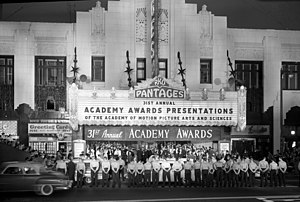
 31st Academy Awards Presentations, Pantages Theater, Hollywood, 1959
 81st Academy Awards Presentations, Hollywood and Highland, Hollywood, 2009The major awards are presented at a live televised ceremony, most commonly in February or March following the relevant calendar year, and six weeks after the announcement of the nominees. It is the culmination of the film awards season, which usually begins during November or December of the previous year. This is an elaborate extravaganza, with the invited guests walking up the red carpet in the creations of the most prominent fashion designers of the day. Black tie dress is the most common outfit for men, although fashion may dictate not wearing a bow-tie, and musical performers sometimes do not adhere to this. (The artists who recorded the nominees for Best Original Song quite often perform those songs live at the awards ceremony, and the fact that they are performing is often used to promote the television broadcast).
The Academy Awards is televised live across the United States (excluding Hawaii; they aired live for the first time in Alaska in 2011), Canada, the United Kingdom, and gathers millions of viewers elsewhere throughout the world.[27] The 2007 ceremony was watched by more than 40 million Americans.[28] Other awards ceremonies (such as the Emmys, Golden Globes, and Grammys) are broadcast live in the East Coast but are on tape delay in the West Coast and might not air on the same day outside North America (if the awards are even televised). The Academy has for several years claimed that the award show has up to a billion viewers internationally, but this has so far not been confirmed by any independent sources. The Awards show was first televised on NBC in 1953. NBC continued to broadcast the event until 1960 when the ABC Network took over, televising the festivities through 1970, after which NBC resumed the broadcasts. ABC once again took over broadcast duties in 1976; it is under contract to do so through the year 2020.[29]
After more than sixty years of being held in late March or early April, the ceremonies were moved up to late February or early March starting in 2004 to help disrupt and shorten the intense lobbying and ad campaigns associated with Oscar season in the film industry. Another reason was because of the growing TV ratings success of the NCAA Men's Division I Basketball Championship, which would cut into the Academy Awards audience. The earlier date is also to the advantage of ABC, as it now usually occurs during the highly profitable and important February sweeps period. (Some years, the ceremony is moved into early March in deference to the Winter Olympics.) Advertising is somewhat restricted, however, as traditionally no movie studios or competitors of official Academy Award sponsors may advertise during the telecast. The Awards show holds the distinction of having won the most Emmys in history, with 47 wins and 195 nominations.[30]
After many years of being held on Mondays at 9:00 p.m. Eastern/6:00 p.m Pacific, in 1999 the ceremonies were moved to Sundays at 8:30 p.m. Eastern/5:30 p.m. Pacific.[31] The reasons given for the move were that more viewers would tune in on Sundays, that Los Angeles rush-hour traffic jams could be avoided, and that an earlier start time would allow viewers on the East Coast to go to bed earlier.[32] For many years the film industry had opposed a Sunday broadcast because it would cut into the weekend box office.[33]
On March 30, 1981, the awards ceremony was postponed for one day after the shooting of President Ronald Reagan and others in Washington, D.C.
In 1993, an In Memoriam segment was introduced,[34] honoring those who had made a significant contribution to cinema who had died in the preceding 12 months, a selection compiled by a small committee of Academy members.[35] This segment has drawn criticism over the years for the omission of some names.
In 2010, the organizers of the Academy Awards announced that winners' acceptance speeches must not run past 45 seconds. This, according to organizer Bill Mechanic, was to ensure the elimination of what he termed "the single most hated thing on the show" – overly long and embarrassing displays of emotion.[36]
The Academy has also had recent discussions about moving the ceremony even further back into January, citing TV viewers' fatigue with the film industry's long awards season. But such an accelerated schedule would dramatically decrease the voting period for its members, to the point where some voters would only have time to view the contending films streamed on their computers (as opposed to traditionally receiving the films and ballots in the mail). Also, a January ceremony may have to compete with National Football League playoff games.[37]
Winners had been announced three months earlier of their triumphs; however that was changed in the second ceremony of the Academy Awards in 1930. Since then and during the first decade, the results were given to newspapers for publication at 11 pm on the night of the awards.[3] This method was used until the Los Angeles Times announced the winners before the ceremony began; as a result, the Academy has used a sealed envelope to reveal the name of the winners since 1941.[3]
For the first six ceremonies, the eligibility period spanned two calendar years. For example, the 2nd Academy Awards presented on April 3, 1930, recognized films that were released between August 1, 1928 and July 31, 1929. Starting with the 7th Academy Awards, held in 1935, the period of eligibility became the full previous calendar year from January 1 to December 31.
The first Best Actor awarded was Emil Jannings, for his performances in The Last Command and The Way of All Flesh. He had to return to Europe before the ceremony, so the Academy agreed to give him the prize earlier; this made him the first Academy Award winner in history. The honored professionals were awarded for all the work done in a certain category for the qualifying period; for example, Emil Jannings received the award for two movies in which he starred during that period. Since the fourth ceremony, the system changed, and the professionals were honored for a specific performance in a single film. As of the 83rd Academy Awards ceremony held in 2011[update], a total of 2,809 Oscars have been given for 1,853 awards.[4] A total of 302 actors have won Oscars in competitive acting categories or been awarded Honorary or Juvenile Awards.
The 1939 film Beau Geste is the only movie that features as many as four Academy Award winners for Best Actor in a Leading Role (Gary Cooper, Ray Milland, Susan Hayward, Broderick Crawford) prior to any of the actors receiving the Best Actor Award.
At the 29th ceremony, held on March 27, 1957, the Best Foreign Language Film category was introduced. Until then, foreign language films were honored with the Special Achievement Award.
Oscar statuette
Design
Although there are seven other types of annual awards presented by the Academy (the Irving G. Thalberg Memorial Award, the Jean Hersholt Humanitarian Award, the Gordon E. Sawyer Award, the Scientific and Engineering Award, the Technical Achievement Award, the John A. Bonner Medal of Commendation, and the Student Academy Award) plus two awards that are not presented annually (the Special Achievement Award in the form of an Oscar statuette and the Honorary Award that may or may not be in the form of an Oscar statuette), the best known one is the Academy Award of Merit more popularly known as the Oscar statuette. Made of gold-plated britannium on a black metal base, it is 13.5 in (34 cm) tall, weighs 8.5 lb (3.85 kg) and depicts a knight rendered in Art Deco style holding a crusader's sword standing on a reel of film with five spokes. The five spokes each represent the original branches of the Academy: Actors, Writers, Directors, Producers, and Technicians.[5]MGM's art director Cedric Gibbons, one of the original Academy members, supervised the design of the award trophy by printing the design on a scroll.[6] In need of a model for his statuette, Gibbons was introduced by his then wife Dolores del Río to Mexican film director and actor Emilio "El Indio" Fernández. Reluctant at first, Fernández was finally convinced to pose nude to create what today is known as the "Oscar". Then, sculptor George Stanley (who also did the Muse Fountain[7] at the Hollywood Bowl) sculpted Gibbons's design in clay and Sachin Smith cast the statuette in 92.5 percent tin and 7.5 percent copper and then gold-plated it. The only addition to the Oscar since it was created is a minor streamlining of the base. The original Oscar mold was cast in 1928 at the C.W. Shumway & Sons Foundry in Batavia, Illinois, which also contributed to casting the molds for the Vince Lombardi Trophy and Emmy Awards statuettes. Since 1983,[8] approximately 50 Oscars are made each year in Chicago by Illinois manufacturer R.S. Owens & Company.[9]
In support of the American effort in World War II, the statuettes were made of plaster and were traded in for gold ones after the war had ended.[10]
Naming
The root of the name Oscar is contested. One biography of Bette Davis claims that she named the Oscar after her first husband, band leader Harmon Oscar Nelson;[11] one of the earliest mentions in print of the term Oscar dates back to a Time magazine article about the 1934 6th Academy Awards.[12] Walt Disney is also quoted as thanking the Academy for his Oscar as early as 1932. Another claimed origin is that the Academy's Executive Secretary, Margaret Herrick, first saw the award in 1931 and made reference to the statuette's reminding her of her "Uncle Oscar" (a nickname for her cousin Oscar Pierce).[13] Columnist Sidney Skolsky was present during Herrick's naming and seized the name in his byline, "Employees have affectionately dubbed their famous statuette 'Oscar'".[14] The trophy was officially dubbed the "Oscar" in 1939 by the Academy of Motion Pictures Arts and Sciences.[15] Another legend reports that the Norwegian-American Eleanor Lilleberg, executive secretary to Louis B. Mayer, saw the first statuette and exclaimed, "It looks like King Oscar II!".[16] At the end of the day she asked, "What should we do with Oscar, put him in the vault?" and the name stuck.Ownership of Oscar statuettes
Since 1950, the statuettes have been legally encumbered by the requirement that neither winners nor their heirs may sell the statuettes without first offering to sell them back to the Academy for US$1. If a winner refuses to agree to this stipulation, then the Academy keeps the statuette. Academy Awards not protected by this agreement have been sold in public auctions and private deals for six-figure sums.[17] In December 2011, Orson Welles' 1941 Oscar for Citizen Kane has been placed up for auction, after his heirs won a 2004 court decision that Welles did not sign any agreement to return the statue to the Academy.[18]While the Oscar is under the ownership of the recipient, it is essentially not on the open market.[19] The case of Michael Todd's grandson trying to sell Todd's Oscar statuette illustrates that there are some who do not agree with this idea. When Todd's grandson attempted to sell Todd's Oscar statuette to a movie prop collector, the Academy won the legal battle by getting a permanent injunction. Although Oscar sales transactions have been successful, some buyers have subsequently returned the statuettes to the Academy, which keeps them in its treasury.[20]
Nomination
Since 2004, Academy Award nomination results have been announced to the public in late January. Prior to 2004, nomination results were announced publicly in early February.Voters
The Academy of Motion Picture Arts and Sciences (AMPAS), a professional honorary organization, maintains a voting membership of 5,783 as of 2012[update].[21]Academy membership is divided into different branches, with each representing a different discipline in film production. Actors constitute the largest voting bloc, numbering 1,311 members (22 percent) of the Academy's composition. Votes have been certified by the auditing firm PricewaterhouseCoopers (and its predecessor Price Waterhouse) for the past 73 annual awards ceremonies.[22]
All AMPAS members must be invited to join by the Board of Governors, on behalf of Academy Branch Executive Committees. Membership eligibility may be achieved by a competitive nomination or a member may submit a name based on other significant contribution to the field of motion pictures.
New membership proposals are considered annually. The Academy does not publicly disclose its membership, although as recently as 2007 press releases have announced the names of those who have been invited to join. The 2007 release also stated that it has just under 6,000 voting members. While the membership had been growing, stricter policies have kept its size steady since then.[23]
Rules
Currently, according to Rules 2 and 3 of the official Academy Awards Rules, a film must open in the previous calendar year, from midnight at the start of January 1 to midnight at the end of December 31, in Los Angeles County, California, to qualify (except for the Best Foreign Language Film).[24] For example, the 2010 Best Picture winner, The Hurt Locker, was actually first released in 2008, but did not qualify for the 2009 awards as it did not play its Oscar-qualifying run in Los Angeles until mid-2009, thus qualifying for the 2010 awards.Rule 2 states that a film must be feature-length, defined as a minimum of 40 minutes, except for short subject awards, and it must exist either on a 35 mm or 70 mm film print or in 24 frame/s or 48 frame/s progressive scan digital cinema format with native resolution not less than 1280x720.
Producers must submit an Official Screen Credits online form before the deadline; in case it is not submitted by the defined deadline, the film will be ineligible for Academy Awards in any year. The form includes the production credits for all related categories. Then, each form is checked and put in a Reminder List of Eligible Releases.
In late December ballots and copies of the Reminder List of Eligible Releases are mailed to around 6000 active members. For most categories, members from each of the branches vote to determine the nominees only in their respective categories (i.e. only directors vote for directors, writers for writers, actors for actors, etc.); there are some exceptions though in the case of certain categories, like Foreign Film, Documentary and Animated Feature Film in which movies are selected by special screening committees made up of members from all branches. In the special case of Best Picture, all voting members are eligible to select the nominees for that category. Foreign films must include English subtitles, and each country can only submit one film per year.[25]
The members of the various branches nominate those in their respective fields while all members may submit nominees for Best Picture. The winners are then determined by a second round of voting in which all members are then allowed to vote in most categories, including Best Picture.[26]
Ceremony
Telecast


The Academy Awards is televised live across the United States (excluding Hawaii; they aired live for the first time in Alaska in 2011), Canada, the United Kingdom, and gathers millions of viewers elsewhere throughout the world.[27] The 2007 ceremony was watched by more than 40 million Americans.[28] Other awards ceremonies (such as the Emmys, Golden Globes, and Grammys) are broadcast live in the East Coast but are on tape delay in the West Coast and might not air on the same day outside North America (if the awards are even televised). The Academy has for several years claimed that the award show has up to a billion viewers internationally, but this has so far not been confirmed by any independent sources. The Awards show was first televised on NBC in 1953. NBC continued to broadcast the event until 1960 when the ABC Network took over, televising the festivities through 1970, after which NBC resumed the broadcasts. ABC once again took over broadcast duties in 1976; it is under contract to do so through the year 2020.[29]
After more than sixty years of being held in late March or early April, the ceremonies were moved up to late February or early March starting in 2004 to help disrupt and shorten the intense lobbying and ad campaigns associated with Oscar season in the film industry. Another reason was because of the growing TV ratings success of the NCAA Men's Division I Basketball Championship, which would cut into the Academy Awards audience. The earlier date is also to the advantage of ABC, as it now usually occurs during the highly profitable and important February sweeps period. (Some years, the ceremony is moved into early March in deference to the Winter Olympics.) Advertising is somewhat restricted, however, as traditionally no movie studios or competitors of official Academy Award sponsors may advertise during the telecast. The Awards show holds the distinction of having won the most Emmys in history, with 47 wins and 195 nominations.[30]
After many years of being held on Mondays at 9:00 p.m. Eastern/6:00 p.m Pacific, in 1999 the ceremonies were moved to Sundays at 8:30 p.m. Eastern/5:30 p.m. Pacific.[31] The reasons given for the move were that more viewers would tune in on Sundays, that Los Angeles rush-hour traffic jams could be avoided, and that an earlier start time would allow viewers on the East Coast to go to bed earlier.[32] For many years the film industry had opposed a Sunday broadcast because it would cut into the weekend box office.[33]
On March 30, 1981, the awards ceremony was postponed for one day after the shooting of President Ronald Reagan and others in Washington, D.C.
In 1993, an In Memoriam segment was introduced,[34] honoring those who had made a significant contribution to cinema who had died in the preceding 12 months, a selection compiled by a small committee of Academy members.[35] This segment has drawn criticism over the years for the omission of some names.
In 2010, the organizers of the Academy Awards announced that winners' acceptance speeches must not run past 45 seconds. This, according to organizer Bill Mechanic, was to ensure the elimination of what he termed "the single most hated thing on the show" – overly long and embarrassing displays of emotion.[36]
The Academy has also had recent discussions about moving the ceremony even further back into January, citing TV viewers' fatigue with the film industry's long awards season. But such an accelerated schedule would dramatically decrease the voting period for its members, to the point where some voters would only have time to view the contending films streamed on their computers (as opposed to traditionally receiving the films and ballots in the mail). Also, a January ceremony may have to compete with National Football League playoff games.[37]
Subscribe to:
Posts (Atom)